
Cost savings marketing leader AI automation tools aren’t hype anymore — they’re showing up in real budget reports. Forrester found that enterprises implementing comprehensive AI marketing automation achieved an average ROI of 186% over three years, with payback periods averaging just 11 months. Klarna’s AI assistant now handles two-thirds of incoming customer chats — doing the work of roughly 700 agents.
But here’s what most articles on this topic get wrong: they either throw out big numbers with no context, or they list 30 tools without telling you which ones actually matter for a marketing leader trying to make a real budget decision.
This guide is different. I’m going to walk you through exactly where cost savings AI automation tools deliver the most value for marketing teams, which specific platforms are worth your money, and how to build a business case that doesn’t get laughed out of your next budget meeting.
Why This Conversation Is Happening Right Now
Marketing budgets aren’t growing the way they used to. Headcount is frozen at a lot of companies. Meanwhile, the expectations haven’t changed — more content, more campaigns, more leads, more revenue attribution.
That mismatch is exactly why cost savings marketing leader AI automation tools have gone from “interesting experiment” to “board-level conversation” in the span of about two years.
A few numbers worth sitting with:
- Organizations using AI-assisted content creation report 84% faster delivery of high-quality content, according to research from Aprimo
- Generative AI tools save marketing professionals an average of 5.4% of their work hours — more than two hours per week per person
- 84% of companies investing in AI report seeing positive ROI from that investment
- A 6-week AI-powered digital asset management implementation at Hachette Book Group saved $15,000 in migration costs alone
None of these are theoretical. They’re documented outcomes from companies that have already made the shift — which means the question for most marketing leaders isn’t whether this works. It’s where to start.
Where Marketing Leaders Are Actually Finding Cost Savings
Not every part of a marketing operation benefits equally from automation. Here’s where cost savings AI automation tools consistently move the needle the most.
Content Production
This is usually the biggest line item in a marketing budget, and it’s where the ROI case is easiest to make.
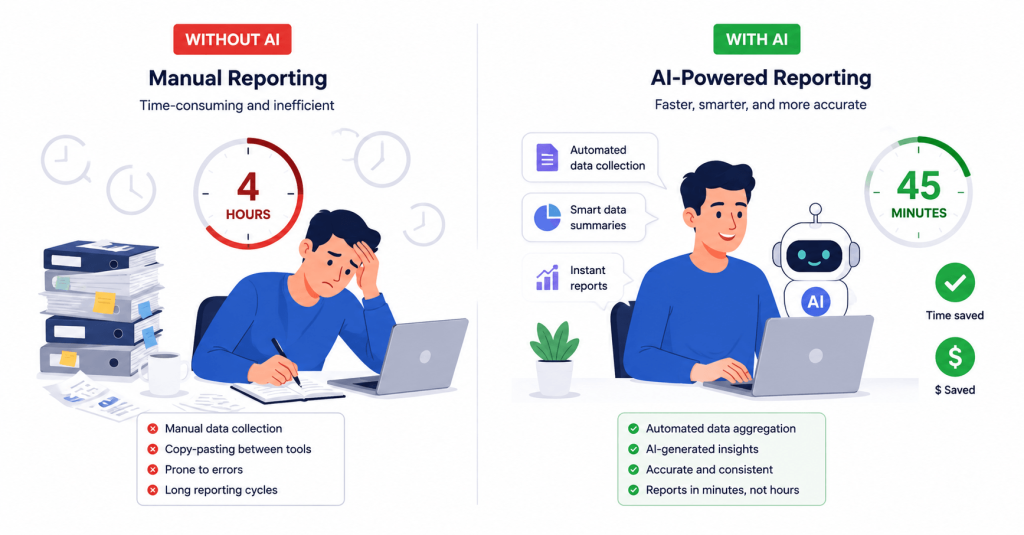
A content writer producing a first draft from scratch typically spends 3–4 hours per piece. With an AI writing tool handling the first draft — and a human editor refining tone, accuracy, and strategy — that same piece takes closer to 45–60 minutes of human time.
Run that math across a team producing 20 pieces of content a month:
- Time saved: roughly 50–60 hours per month
- At a fully loaded rate of $40/hour, that’s $2,000–$2,400/month in labour reclaimed
- Tool cost: typically $50–$150/month
Tools like Jasper, Copy.ai, and Writer all play in this space. Jasper in particular has built a Brand Voice feature that learns your tone over time, which cuts down review cycles — a detail that matters more than people expect once you’re producing content at volume.
Paid Media Management
Manual ad management has a built-in lag problem. By the time a human notices an underperforming campaign and adjusts the bid or audience, budget has already leaked.
AI-driven platforms like Madgicx, Adalysis, and Revealbot monitor performance continuously and adjust in real time — bidding, audience targeting, creative rotation — without waiting for a weekly review meeting.
Marketing leaders managing $50K+/month in paid spend typically report 10–20% improvements in ROAS after adopting AI-assisted optimization. On a $50K monthly budget, that’s $5,000–$10,000/month in either reclaimed waste or improved output from the same spend.
Reporting and Analytics
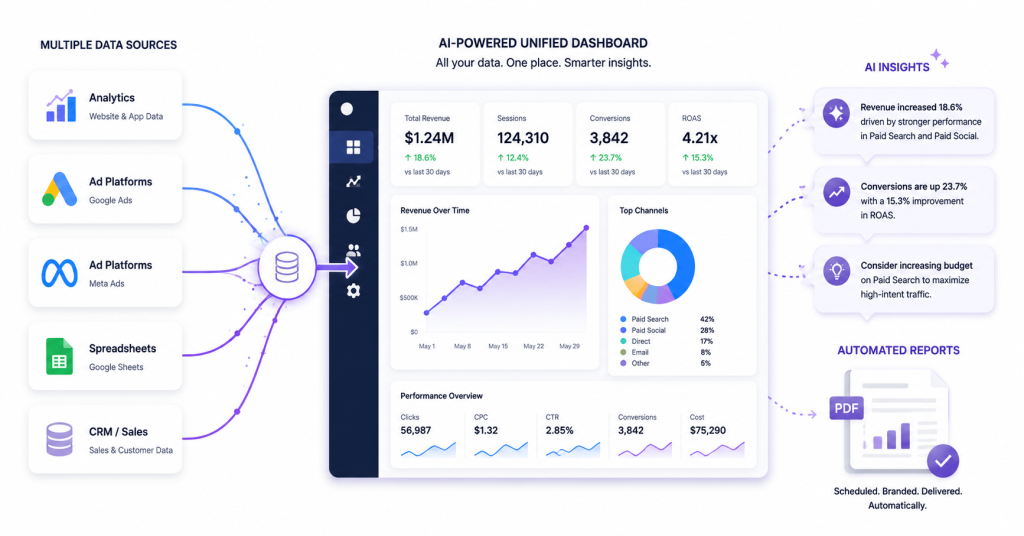
This one is underrated. The actual labour cost of pulling data from five different platforms, building a deck, and writing commentary every week adds up fast — and it’s almost entirely automatable now.
Platforms with AI-assisted reporting (Looker, Triple Whale, Databox) pull data automatically and generate plain-language summaries of what changed and why. One source I came across — MarketBetter — suggests a simple exercise: track how many hours your team spends on manual reporting for one week, multiply by 52, and that’s your annual labour cost tied directly to a task AI can largely absorb. It’s a clean, board-friendly way to frame the savings.
Email and Lifecycle Marketing
Personalizing email at scale used to require either a large team or a lot of shortcuts — generic segments, broad send times, one-size-fits-all subject lines.
AI-native platforms like Klaviyo and ActiveCampaign now handle send-time optimization, predictive segmentation, and behaviour-based triggering automatically. For a list of 50,000+ subscribers, this is work that previously required a dedicated CRM specialist — now it’s largely handled by the platform itself.
Workflow and Process Automation
A huge chunk of marketing operations is genuinely repetitive — moving data between tools, triggering follow-ups, updating spreadsheets, syncing CRM records.
Zapier remains the most widely used tool here, connecting over 7,000 applications so data moves without manual copy-paste. Newer entrants like Gumloop add an AI layer on top of that same idea — letting you build automated workflows that include AI decision-making steps, not just simple triggers.
This category doesn’t always get the spotlight, but it quietly removes hours of low-value work every week — work that, left unaddressed, eats into the time your team should be spending on strategy.
A Practical Tool Breakdown by Category
| Category | Tool | What It Solves | Starting Price |
|---|---|---|---|
| Content Creation | Jasper | High-volume content with brand voice consistency | $49/month |
| Content Creation | Copy.ai | Fast-turnaround marketing copy | $49/month |
| Paid Media | Madgicx | AI bid and audience optimization | $44/month |
| Paid Media | Adalysis | PPC performance analysis | $99/month |
| Email/Lifecycle | Klaviyo | Predictive segmentation, send-time AI | Free up to 250 contacts |
| Email/Lifecycle | ActiveCampaign | Behaviour-triggered automation | $15/month |
| Reporting | Databox | Automated dashboards across platforms | Free tier available |
| Reporting | Triple Whale | Unified analytics with AI summaries | $129/month |
| Workflow Automation | Zapier | Connects 7,000+ apps, eliminates manual data entry | Free tier available |
| Workflow Automation | Gumloop | AI-layered workflow automation | Free tier available |
This isn’t an exhaustive list — it’s a starting point organized around the problems marketing leaders actually have, not a generic “30 tools” roundup.
How to Build the Business Case Your CFO Will Actually Approve
Knowing that cost savings AI automation tools work in general isn’t enough. You need a specific, defensible case for your specific team. Here’s a process that holds up under scrutiny.
Step 1: Find Your Most Expensive Manual Process
Ask your team to track time for one week — not vague impressions, actual hours logged against specific tasks. Reporting, content drafts, campaign setup, list segmentation. You’ll usually find one or two processes eating a disproportionate share of hours.
Step 2: Put a Dollar Figure on the Current Cost
Multiply the hours by the fully loaded hourly cost of the people doing the work. Annualize it. This number is almost always bigger than people expect — often $10K–$30K/month in labour tied to tasks that don’t require human judgment.
Step 3: Match the Tool to the Specific Problem
Don’t start by browsing “best AI marketing tools” lists. Start with the expensive process you just identified, and find the tool built specifically to address it. This keeps the investment focused and the ROI calculation clean.
Step 4: Run a Real Pilot, Not a Demo
Pick one tool, one process, one owner on your team, and run it for 30 days. Track hours saved and output quality against your baseline. A clean before/after comparison is far more persuasive to a CFO than any vendor’s case study slide.
Step 5: Scale What’s Proven, Cut What Isn’t
Not every cost savings marketing leader AI automation tool delivers the same way for every team. What works for a 5-person startup marketing team can be the wrong fit for a 50-person enterprise function. Let the pilot data — not the hype — decide what gets scaled.
Mistakes That Quietly Kill the ROI
❌ Buying the tool before identifying the problem. The most expensive purchases are the ones made because a tool was trending, not because it solved something specific.
❌ Treating AI as a replacement for judgment, not an amplifier of it. The strongest results come from AI handling volume and routine work while your team keeps ownership of strategy, brand voice, and final decisions.
❌ Underestimating setup time. Most platforms take 4–8 weeks to properly configure, train on your brand, and integrate with your CRM. Build that into your timeline — and your ROI expectations.
❌ Skipping the baseline measurement. If you don’t document current costs and hours before rolling out a tool, you have no clean way to prove savings later — which makes renewal and expansion conversations much harder.
❌ Trying to automate everything simultaneously. Marketing leaders who attempt a full operational overhaul at once tend to create more confusion than savings. One process, proven, then expand.
❌ Choosing a tool with weak integrations. A platform that doesn’t connect cleanly to your CRM creates data silos and manual workarounds — which defeats the entire point. Ask for technical documentation, not just a sales pitch, before committing.
What This Looks Like at Real Scale
Here’s a realistic picture for a mid-size marketing team of around 8 people managing a $500K annual budget:
| Area | Monthly Tool Cost | Monthly Labour Reclaimed | Net Monthly Saving |
|---|---|---|---|
| Content (Jasper) | $150 | $2,400 | $2,250 |
| Paid media (Madgicx) | $100 | $1,800 | $1,700 |
| Email (ActiveCampaign) | $150 | $1,100 | $950 |
| Reporting (Databox) | $100 | $1,400 | $1,300 |
| Workflow (Zapier) | $100 | $900 | $800 |
| Total | $600/month | $7,600/month | $7,000/month |
That works out to roughly $84,000 in annual savings against a $7,200/year tool spend — a number that lines up closely with what Forrester’s broader research on AI marketing ROI has documented across larger samples.
Even accounting for setup time and a learning curve, the case for cost savings marketing leader AI automation tools holds up well under real scrutiny — not just vendor marketin
Final Thoughts
The marketing leaders pulling ahead right now aren’t necessarily working with bigger budgets. They’re the ones who identified their most expensive manual process, matched it to the right tool, and proved the ROI before scaling further.
Cost savings marketing leader AI automation tools aren’t a single silver-bullet platform — they’re a category of solutions, each addressing a specific cost center: content, paid media, reporting, email, workflow. The leaders getting real results picked one, measured it honestly, and built from there.
That’s a far more useful starting point than another list of 30 tools you’ll never actually evaluate properly.
Read More Article – WordPress vs Wix